
Most Agile-to-Propel migrations take 3–12 months. The exact timeline depends on scope, data readiness, integrations, validation requirements, and how quickly key decisions are made.
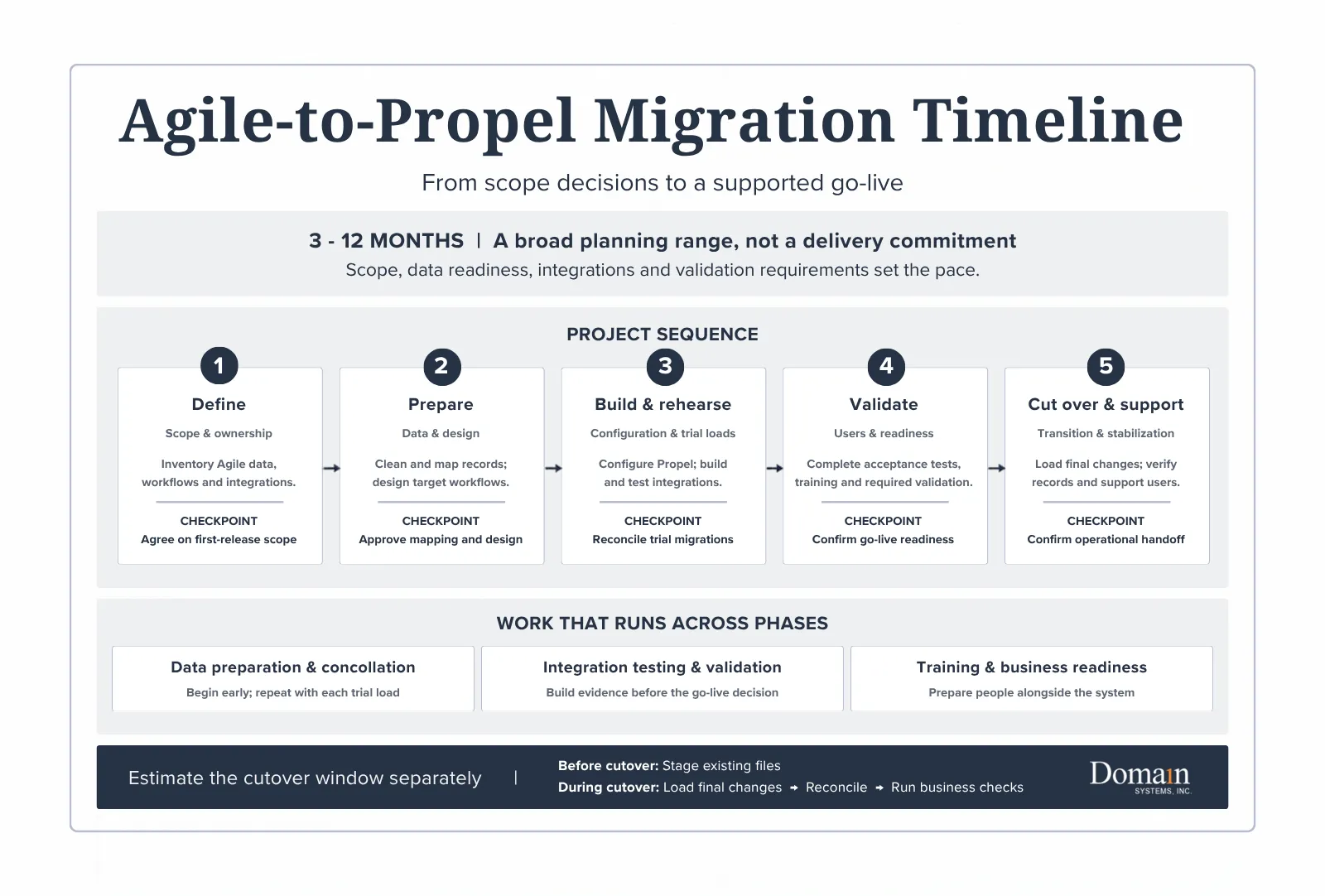
Plan around 3–12 months for an Agile-to-Propel migration, then refine that estimate through discovery. Domain Systems’ published planning ranges run from 3–5 months for a small Agile instance to 9–12 months for a large or heavily customized deployment. They are starting points, not delivery commitments.
That gives you a number for the first budget conversation. It doesn’t give you a date to announce though.
To get there, you need to ask a second question:
What needs to be true before we can call this migration complete?
Start with a range, then define the finish line
Our Agile-to-Propel migration process overview outlines these planning ranges:
| Agile environment | Initial planning range |
| Small instance | 3–5 months |
| Mid-sized regulated environment | 6–9 months |
| Large or heavily customized deployment | 9–12 months |
An environment’s complexity matters more than its label. A smaller manufacturer may have substantial validation requirements or a business-critical custom integration. A larger company may start with one tightly defined release.
Before comparing estimates, establish their boundaries:
- Start: Does the clock include discovery and data preparation, or begin after those are complete?
- Finish: Does it end at production go-live, after stabilization, or when Agile can be retired?
- Coverage: Does it include every site and process, or only the first release?
The complete enterprise guide to Propel PLM implementation provides the broader framework, including a 3–6-month planning range for standard projects.
An Agile migration adds its own legacy-data and transition requirements. Compare the scope behind the numbers.
Why four weeks is a different animal
Domain’s Propel FastStart establishes a core PLM baseline in four weeks. Its core scope excludes data migration, customization, and QMS.
That distinction matters. A configured platform and a completed Agile migration are different milestones.
Think of it as preparing a new workshop. The benches and power can be ready before the equipment has been moved, calibrated, and cleared for production.
FastStart can serve a defined implementation need. Its four-week schedule should not become the assumed duration of the entire transition.
What actually moves the migration date?
1. Decisions that have nowhere to land
Consider a familiar situation: Engineering wants to preserve an approval step. Operations questions its purpose. Quality needs to check why it was introduced.
The configuration work may be straightforward. Reaching an approved decision takes longer.
A schedule needs room for both. Assign an owner, an approver, and a due date to each consequential decision. Reserve their time before the project starts.
“Available as needed” is difficult to put on a calendar.
2. Data that needs interpretation
Record counts and file sizes help estimate technical work. They do not tell you whether a historical revision is required, an attachment is authoritative, or an obsolete item still supports a product in service.
Those questions require business judgment.
In Engineering.com’s Developing the PLM Roadmap, Lionel Grealou identifies data cleansing and archiving as frequently underestimated planning activities. Assuming the business will sort them out later leaves real work outside the schedule.
Classify what must move, what can remain accessible in an archive, and who approves those choices. Our five questions before migrating from Agile to Propel provide a starting point.
3. Connections that must work together
An engineering change can look correct in Propel while its downstream ERP transaction still needs work.
Test the complete business sequence: release the change, transfer the intended information, confirm the receiving system’s response, and handle an exception.
Where formal validation applies, plan the required evidence and approvals early. Passing a test and completing its review are separate activities.
Preparing to Move from Agile PLM?
A migration begins long before data is transferred or workflows are configured. If you are evaluating a move from Oracle Agile PLM to Propel, our Migration Readiness Guide covers the scope, data, ownership, integration, validation, and cutover decisions that should be addressed before implementation begins.
Project duration is not the same as downtime
Here is a useful distinction.
In Propel’s data migration planning session, Jeff Nichols, VP of Professional Services at Domain Systems, describes staging file-vault content before the final migration, then transferring subsequent changes through a delta load.
The implication: a large file vault does not automatically require moving every file during the cutover window.
Think of moving a library.
Most books can be packed ahead of time; the final move must also account for what was borrowed, returned, or changed since packing began.
The approach still needs rehearsals. Measure the final load, reconciliation, business checks, and go/no-go decision in a representative trial. Those results establish a credible cutover window. The overall project estimate cannot answer that question by itself.
How to shorten the timeline without borrowing trouble
Focus on removing uncertainty before it creates rework:
- Define a complete first release. Specify the products, users, workflows, history, and integrations needed for day-one operations.
- Test representative data early. Include difficult revisions, attachments, and relationships, not just clean examples.
- Protect business-owner time. Book workshops, decisions, testing, and approvals alongside technical work.
- Plan the handoff. Set stabilization exit criteria and name the team that will own the operating system.
Ask your implementation partner which unresolved dependency currently controls the go-live date, who owns it, and what evidence will clear it.
That makes the schedule a management tool, rather than a date everyone hopes to keep.
That emphasis on ownership is reflected in ProNova Solutions’ experience moving from Agile to Propel:
“End-to-end ownership kept the transition controlled and predictable.”
— Amy Bellendir, Sr. Business Analyst, ProNova Solutions
In her account of the migration, Bellendir credits Domain Systems with coordinating the data migration, configuration, and project delivery.
Build a timeline your team can use
A useful estimate explains its assumptions, the work it includes, and the decisions that could change it.
Download the Agile-to-Propel Migration Guide for the migration phases, responsibilities, and post-go-live accountability framework. Use it to bring IT, Engineering, Operations, and Quality into the same planning conversation before committing to a date.