
An Agile-to-Propel migration is typically planned across 3–12 months, but the calendar should be refined through discovery. Scope, data readiness, integrations, validation requirements, and business decisions determine where a project falls within that range.
This infographic maps five phases from initial scope definition through supported go-live. It also shows the work that continues across phases – and why the final cutover window requires a separate estimate.
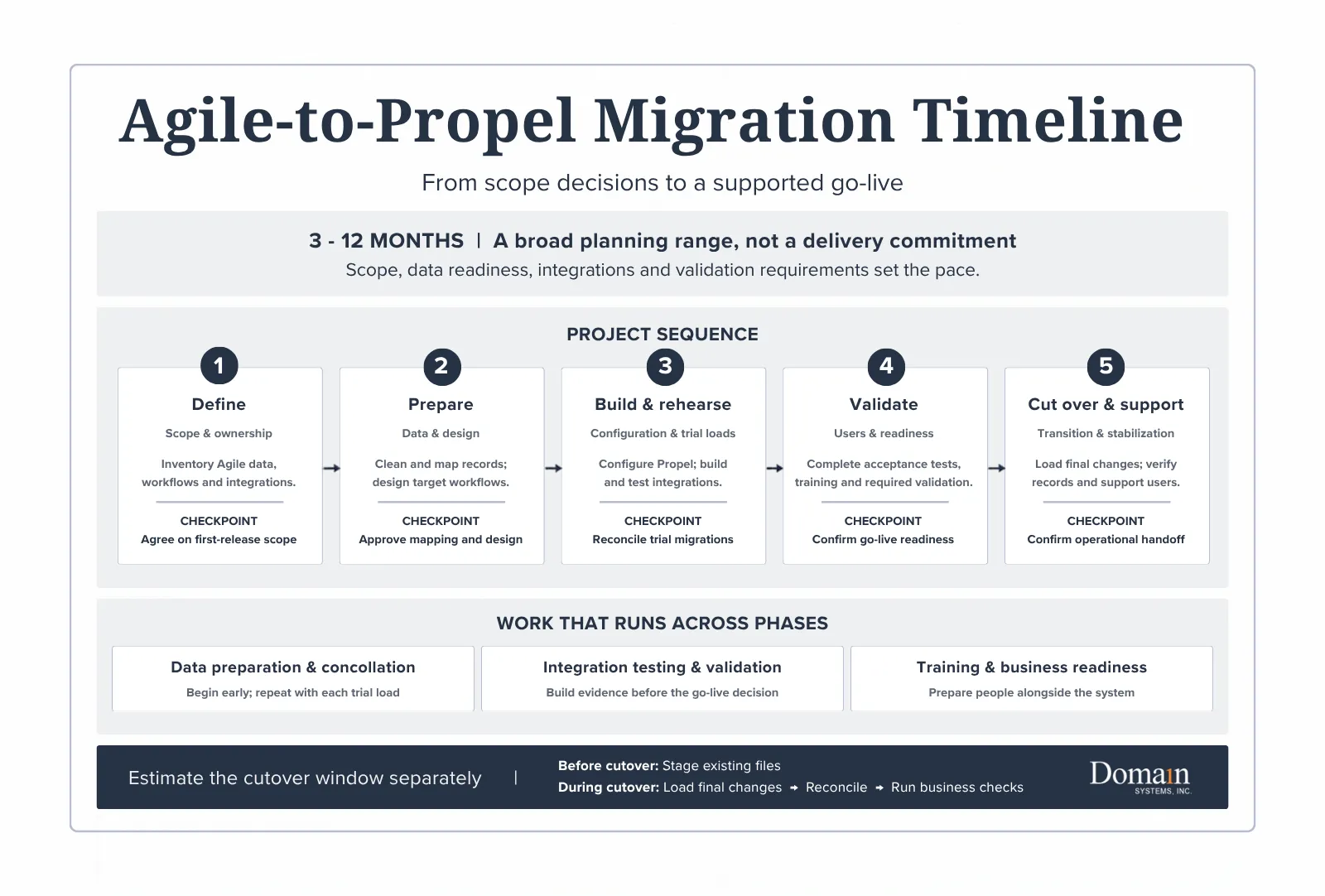
A typical Agile-to-Propel migration spans 3–12 months. Scope, data readiness, integrations, validation requirements, and business decisions determine the pace.
What the infographic shows
An Agile-to-Propel migration can be organized around five phases:
- Define: Inventory Agile data, workflows, and integrations. Establish ownership and agree on the first-release scope.
- Prepare: Clean and map records, design target workflows, and approve the proposed mapping and design.
- Build and rehearse: Configure Propel, build and test integrations, perform trial loads, and reconcile migrated records.
- Validate: Complete acceptance testing, training, required validation, and the final assessment of go-live readiness.
- Cut over and support: Load final changes, verify records, support users, stabilize operations, and complete the ownership handoff.
Data preparation, integration testing, validation, training, and business readiness continue across these phases. They are not one-time tasks that can be placed neatly inside a single project box.
Project duration and cutover are separate estimates
The overall project timeline includes discovery, decisions, preparation, configuration, migration rehearsals, testing, validation, training, and stabilization.
The cutover window covers a narrower sequence: staging existing files, loading final changes, reconciling records, completing business checks, and making the go-live decision. A representative rehearsal is the best way to estimate that window.
Planning an Agile-to-Propel migration?
A credible timeline explains its assumptions, scope, dependencies, responsibilities, and definition of completion.
Download the Agile-to-Propel Migration Guide for a more detailed view of migration phases, stakeholder responsibilities, ETL cycles, common failure points, and post-go-live accountability.