


A Propel implementation connects more than product data. Engineering, Quality, Operations, Sales, and Service may all depend on the same governed product record, while implementation decisions determine ownership, permissions, integrations, validation requirements, and how information moves between systems. This infographic illustrates the relationships that should be defined before configuration and deployment begin.
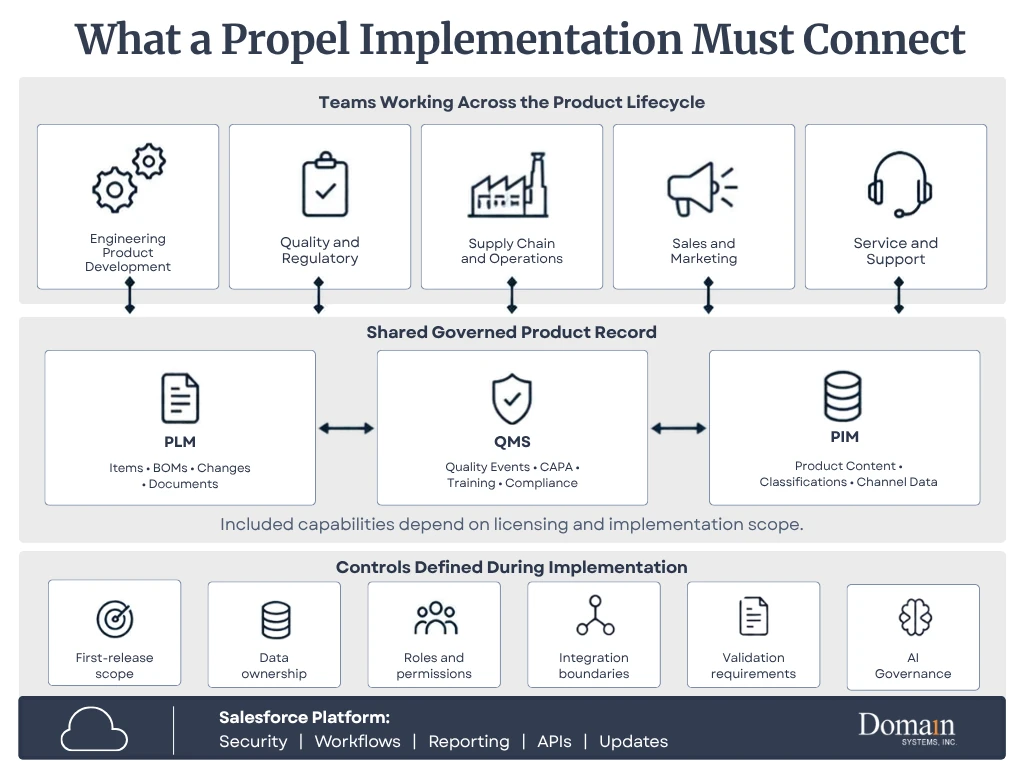
A Propel implementation connects cross-functional teams through a governed product record while defining ownership, access, integrations, validation, and governance.
What the infographic shows
A successful Propel implementation brings three layers together:
- Business teams: Engineering, Quality, Supply Chain, Sales, Marketing, Service, and Support.
- The governed product record: PLM, QMS, and PIM capabilities operating across a shared platform.
- Implementation controls: Scope, data ownership, roles and permissions, integration boundaries, validation requirements, and AI governance.
Propel runs on the Salesforce platform, providing shared security, workflows, reporting, APIs, and platform services beneath these capabilities. The exact combination of PLM, QMS, PIM, and related functionality depends on licensing and implementation scope.
Planning a Propel Implementation?
The technology is only one part of implementation readiness. Scope, ownership, integrations, governance, data, and organizational responsibilities should be understood before configuration begins.
Read the Practical Guide to PLM Implementation